
How to Get Paid Faster at Your Law Firm
Slow-paying clients are a cash-flow problem you can fix. A practical guide to getting paid faster at your law firm: clear bills, online payments, payment plans, autopay, and follow-up that stops the moment a client pays.

You did the work. You sent the bill. And then… nothing. Thirty days. Sixty. The invoice sits in a client's inbox next to a dozen others, and your firm — which has already paid its associates, its rent, and its filing fees — quietly floats the cost.
Aged accounts receivable is one of the most common and most fixable problems in a law practice. The money is owed; it's just stuck. Below are the levers that actually move it, roughly in order of impact.
General information, not legal advice. A few tactics here — surcharging, retainers, trust handling — carry ethics dimensions that vary by state. Check your bar's rules before you adopt them.
 The easiest invoice to ignore is the one that's hard to pay. Make paying the path of least resistance.
1. Bill clearly, and bill promptly
The longer the gap between the work and the bill, the fuzzier the value feels to the client — and the slower they pay. Send invoices while the matter is fresh, not just in a monthly batch. Make the bill itself easy to read: what was done, what it costs, what's due, and by when. Confusing line items generate emails, and emails generate delay.
This is also a trust issue handled well: if you're billing against a retainer, show the client what was applied and what remains. Transparency shortens the distance to payment.
2. Let clients pay the way they pay everything else
Your clients buy almost everything online, instantly. Then they get a legal bill that asks them to write a check and find a stamp. Every extra step is a reason to set it aside.
The single highest-leverage change most firms can make is accepting online payment on a branded page — card, ACH bank transfer, and Apple Pay / Google Pay. A pay link in the invoice email turns "I'll get to it" into thirty seconds of tapping. ACH keeps costs low for large balances; cards and wallets win on convenience for everything else.
A quick note on cost: you can choose to absorb processing fees or, where your jurisdiction allows, pass a compliant surcharge to the client. Two hard rules if you take cards for legal work: a surcharge has to follow card-network and state rules, and when a client pays a retainer into trust, the processing fee must come from your operating account — never out of the client's trust principal.
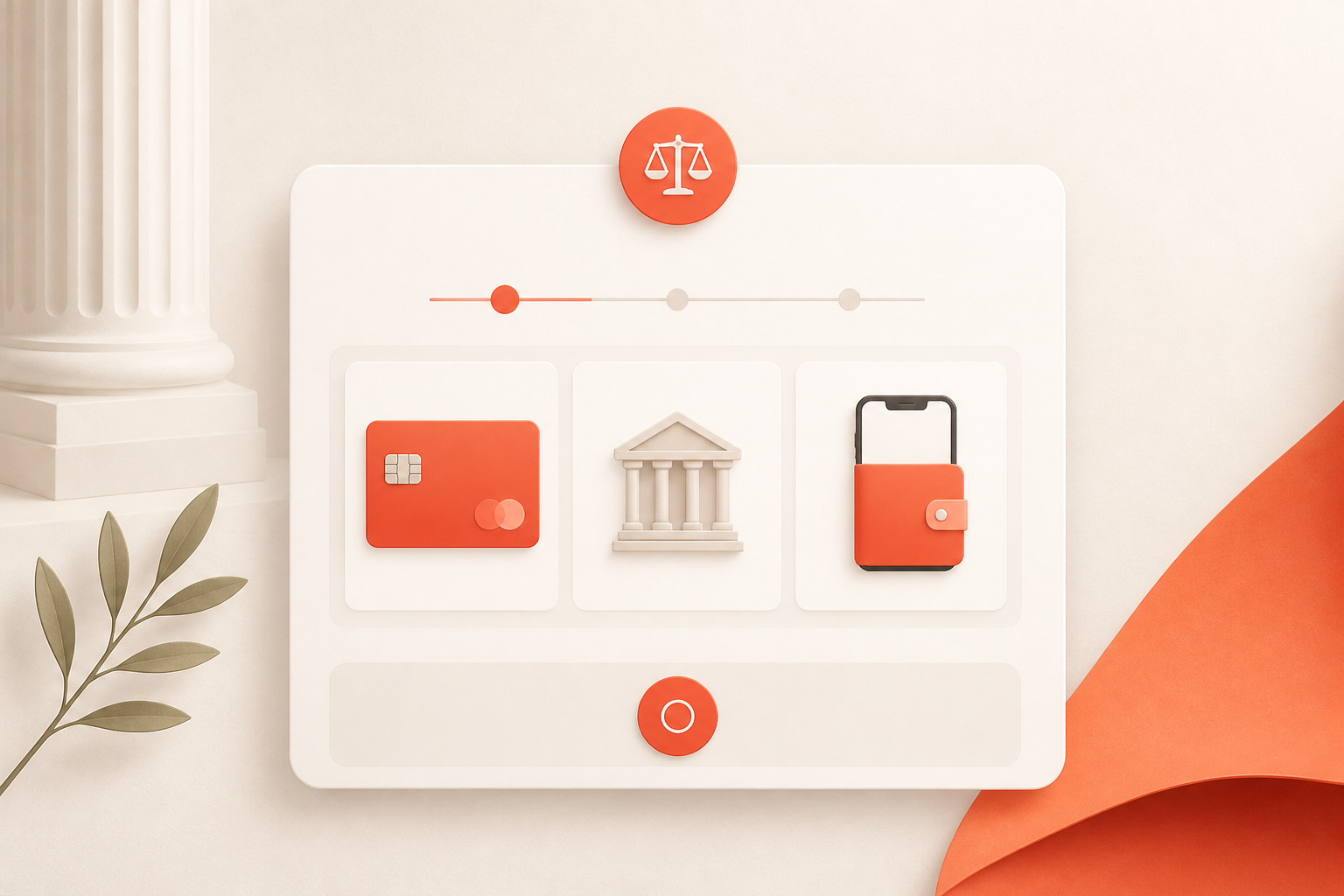 Card, ACH, or wallet — on a branded page that looks like your firm, not a generic processor.
3. Turn big balances into payment plans
A $9,000 invoice can feel impossible to a client and so it gets avoided entirely. The same $9,000 split into six monthly payments feels manageable — and you collect all of it instead of chasing it.
Offer payment plans for larger matters, and pair them with autopay so each installment is charged on schedule without anyone lifting a finger. You convert an awkward lump sum into predictable, automatic cash flow, and the client gets a path to "yes" instead of a reason to stall.
4. Keep ongoing matters funded with evergreen retainers
For litigation and other long-running work, the cash-flow problem isn't a single invoice — it's the slow drift of a retainer toward zero. An evergreen retainer sets a floor: when the trust balance dips below a threshold, it's automatically topped back up, so you're never working on credit and never stopping work to chase a refill. The client agrees to the arrangement once; the replenishment runs quietly in the background.
5. Automate follow-up — and make it stop the instant they pay
Most overdue invoices aren't refusals. They're forgotten. But manual follow-up is uncomfortable and easy to skip, so it doesn't happen — and the balance ages.
A simple, polite reminder sequence over email (and SMS, where appropriate) recovers a surprising amount of receivable with zero awkward phone calls. The detail that matters: reminders must stop the moment the client pays. Nothing erodes goodwill like a "you owe us" notice that lands the day after someone paid. Done right, automated follow-up feels like good service, not nagging.
6. Reduce surprise before the bill ever goes out
The fastest-paying invoices are the ones the client expected. Set fee expectations in the engagement letter. Take a deposit up front where it fits the matter. Send interim updates on larger engagements so the final number is never a shock. A client who understands the bill pays it; a client who's surprised by it calls to argue.
Put it together
You don't need all six at once. Stacked in order, they compound:
- Clear, prompt bills so the value is obvious.
- Online payment so paying takes seconds.
- Payment plans + autopay so big balances don't stall.
- Evergreen retainers so ongoing work stays funded.
- Automated, payment-aware reminders so nothing ages quietly.
- Up-front clarity so the bill is never a surprise.
This is the workflow PayLawyers is designed around: branded pay pages that take card, ACH, and wallets; payment plans with autopay; trust requests and evergreen replenishment for ongoing matters; and a collections queue with reminders that automatically stop the second a client pays. The point isn't to squeeze clients — it's to remove every bit of friction between "I owe my lawyer" and "paid," so the money you've already earned actually reaches your account.
Curious what faster collections would look like for your firm? Book a demo and we'll walk through it on your numbers.